Tax certificate for personal care services
In France, companies in the personal care services sector issue an annual tax certificate, which enables their clients to reclaim a portion of the sums paid, in the form of an income tax credit equal to a percentage of the expenditure, subject to a maximum limit.
As the French administration’s tendency towards over-complication is well known, a number of ‘improvements’ have been introduced. Thus, in 2018, the maximum limit is 12,000 euros, adjustable according to the number of children and parents, with disabled people counting for more, but with a limit of 5,000 euros for gardening, €3,000 for IT support, and €500 for DIY, bearing in mind that a single session must not exceed two hours. It is the beneficiary’s responsibility to check these thresholds and to declare the correct amounts in the correct boxes.
===== ===== Workflow
Prior to producing tax certificates, the following workflow must be followed:
- recording service visits in Gestan
- generating invoices from the service visit list screen
- collecting payment for invoices from the invoice list screen
Generating personal service tax certificates
Access: Via the context menu of the service list
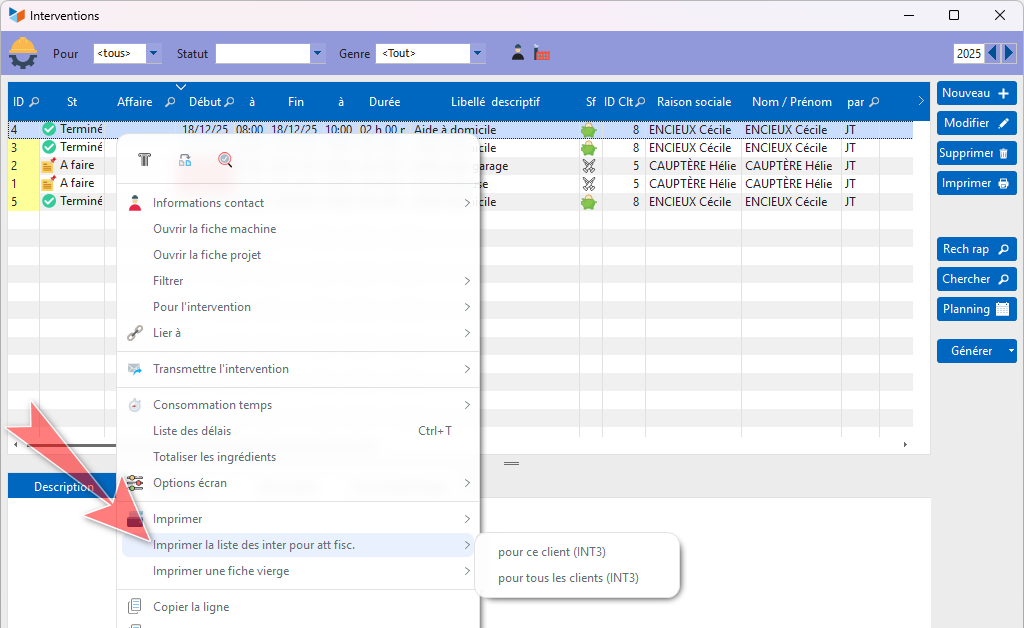
The context menu for the service list allows you to request the printing of certificates for a single client or for all clients, for a specific date range (normally the tax year).
The screen that opens next allows you to enter the necessary parameters.
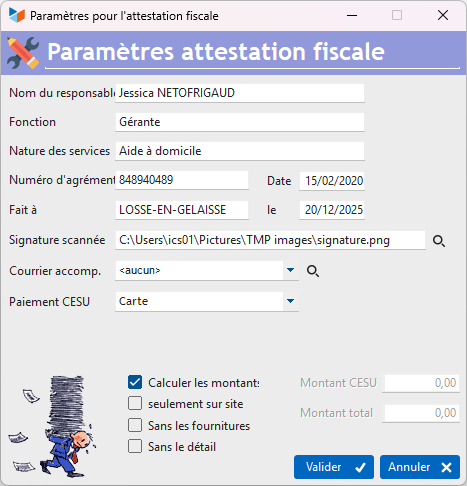
The following must be entered: the Name of the manager and their role, the nature of the services, the approval number and the date of authorisation of the company for personal care services.
Below, please also provide the location (done at) and the date on which the certificate was drawn up. Certificates may be signed by hand or a scanned signature. It is also possible to print an cover letter.
The calculation of amounts paid distinguishes between amounts paid via CESU (Chèque Emploi Service Universel, a payment method used in France) and other payment methods; this is why you must specify which of the payment methods you have set up represent a CESU payment (call it ‘CESU’ in the payment method settings).
The ‘Calculate amounts’ allows you to choose whether or not to calculate the amounts paid by the customer. These are calculated based on the entries recorded as payment for invoices issued within the specified date range. If you are requesting the certificate for a single customer, you can set the amounts to any value of your choice.
The On-site only allows you to include only those jobs carried out at the customer’s site.
The Exclude supplies allows you, if you have requested the calculation of totals, to exclude from these totals any invoice line for a product belonging to a ‘supplies’ product family (as supplies would not qualify for tax relief…) If a product line has no product code, or if the product cannot be found in the product table (as is the case with non-catalogue products), it is by default considered a “supply”, so the product line is excluded from the total.
You can also choose whether or not to publish the list of services. This is what the Without details.
Below is an example of a tax certificate for personal care services.

Breakdown of the calculation of amounts
These certificates are issued on the basis of the recorded receipt entries (payments actually made). An invoice issued on 31 December, but for which payment is made on 5 January of the following year, would therefore not be taken into account for year N, but for the year in which payment is made, in this case N+1.
Reference documents
All personal care service providers must issue an annual tax certificate to each of their clients by 31 March of year N+1, to enable them to claim the tax benefit (tax credit) for year N.
This certificate must state:
- the name and address of the service provider,
- the registration number and date of the declaration,
- the name and address of the person who received the service and, where applicable, the number of the account from which payment was debited,
- a summary of the services provided (names and identification numbers of the service providers, dates and durations of the services). For the sake of simplicity, if the services were provided daily or at regular intervals, a monthly summary of the services provided may be drawn up,
- the amount actually paid.
Where services are paid for using pre-funded CESU vouchers, the certificate must inform the client that they are required to clearly identify to the tax authorities, when submitting their annual tax return, the amount of CESU vouchers they have personally funded, as only this amount qualifies for tax relief.
This clarification will be made possible, in particular, by the issue, by legal entities that pre-fund CESU vouchers (employers, pension funds, mutual insurance schemes, etc.), of an annual certificate to the beneficiary setting out the number, the amount and the pre-financed portion of the CESUs allocated to them.
See also http://www.servicesalapersonne.gouv.fr
ℹ️ Other ‘Activity’ articles
On the same topic: URSSAF extension for calculating the immediate tax credit advance